

Why Madison, CT Keeps Showing Up on Best-Places-to-Live Lists
Looking at the bigger picture? See the Connecticut Shoreline Guide to compare all 24 CT shoreline towns from Greenwich to Mystic.
If you spend any time reading “Best Places to Live” lists for Connecticut — Niche, Money Magazine, Coastal Living, Realtor.com, the various Patch and Hartford Magazine roundups — you notice something. Madison, CT keeps showing up. Not always at #1. Not always with the highest scores. But consistently, year after year, list after list. After 20 years selling Connecticut shoreline real estate, I have a theory about why.
This guide explains what’s actually driving Madison’s persistent rankings, what the lists capture and what they miss, and who Madison is genuinely the right move for. If you’d rather skip to live inventory, you can browse current Madison, CT listings here.
What the Rankings Actually Measure
The “Best Places to Live” lists almost all share a similar methodology: a weighted composite of public school performance, crime rates, median income, housing affordability relative to income, commute time, civic amenities, and population stability. Madison scores well across all of those, but it scores exceptionally well on a few specific factors that drive its repeated rankings.
| Factor | Madison’s Standing | Why It Matters for Rankings |
|---|---|---|
| Madison Public Schools rating | Top 15 in CT | Single biggest factor in most rankings |
| Daniel Hand High School | Top 5% in CT public high schools | Heavily weighted in education scores |
| Violent crime rate | Among CT’s lowest | Major weight in safety scores |
| Median household income | ~$140,000+ | Above CT average; rewards on income metrics |
| Hammonasset Beach State Park access | Largest shoreline park in CT | Boosts amenity scores meaningfully |
| Population stability | Low turnover | Civic continuity scores reward this |
| Walkable downtown anchor | R.J. Julia bookstore, restaurants | Helps “small-town charm” qualitative scores |
What this combination produces is a town that satisfies the criteria almost every ranker uses without scoring badly on any single dimension. Madison rarely tops a list on one factor alone, but it almost never scores poorly on anything.
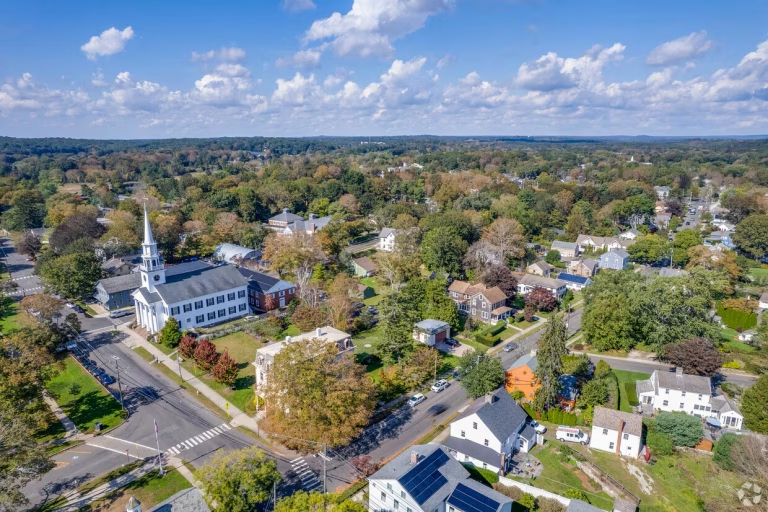
[INSERT YOUR PHOTO OF MADISON GREEN OR HAMMONASSET BEACH HERE]
Suggested caption: A photo of Madison Green with R.J. Julia in the background, or sunrise at Hammonasset Beach. Original local photography helps Google’s quality signals.
What the Rankings Don’t Capture About Madison
The lists capture the measurable. They do not capture the texture. After two decades helping buyers move to Madison, here is what the data does not show.
The “Stay” Effect
Buyers who move to Madison tend not to leave. I have closed deals on the same home — buyer’s first purchase, then resale 20-25 years later when the kids are grown — more times in Madison than in any other CT shoreline town. The stability is real, and it is felt in everything from PTO continuity to multi-generational neighborhood relationships.
The R.J. Julia Effect
It sounds odd to say that a single bookstore shapes a town’s identity, but in Madison it does. R.J. Julia is one of the most respected independent bookstores in America, with a year-round author event calendar that brings national writers to downtown Madison every week. The bookstore anchors a downtown culture that is genuinely literary, civic, and intellectual in a way that few small CT towns can claim.
The Hammonasset Difference
Living minutes from Hammonasset Beach State Park — the largest shoreline park in Connecticut — is materially different from living minutes from a private beach association or a town-only public beach. Hammonasset offers two miles of public Long Island Sound coastline, a nature center, camping, and the kind of outdoor scale you do not associate with Connecticut. For families with kids and outdoor adults, this is the asset that moves the needle.
The Hand High School Network
Daniel Hand High School is consistently a top-5% Connecticut public high school. Beyond the test scores and college placement, what graduates and parents talk about is the network effect — a small enough school that students know each other across grades, a strong arts and athletics program, and an unusually deep alumni network that returns to Madison’s town events for decades.
Who Madison Is Genuinely Right For
Madison’s persistent ranking masks a fairly specific buyer profile that the town fits best:
- Families with school-age children who are willing to pay a premium for top public schools and shoreline access in one package
- Buyers planning long-term holds. Madison’s appreciation is steady rather than dramatic; it rewards patience.
- Hybrid or remote professionals who do not need a daily NYC commute. Madison is too far from Manhattan (~85 minutes by train via Shore Line East + Metro-North) for a daily commute, but works well for 1-2 office days a week.
- Buyers prioritizing civic and cultural community over urban convenience. Madison’s identity revolves around the schools, the bookstore, the beach, the downtown events calendar.
Who Madison Is Wrong For (And What to Look At Instead)
- Daily NYC commuters. The shoreline-east commute from Madison to Grand Central is too long for a daily routine. Look at Greenwich, Stamford, or Fairfield instead.
- Buyers wanting urban density and restaurant culture. Madison’s downtown is charming but small. New Haven or Stamford are the urban answers.
- Investors looking for rapid appreciation. Madison’s market is stable, not dramatic. The case is long-term hold, not fast flip.
- Buyers wanting the cheapest shoreline entry point. Madison commands a premium. Clinton, East Haven, or New London offer more affordable shoreline options.
Madison Home Prices and the 2026 Reality Check
Madison is one of the more expensive central-shoreline towns. Median home prices sit in the $725,000-$825,000 range in 2026, with the larger restored historic homes near downtown clearing $1 million and waterfront properties on Tuxis Island Road and Middle Beach trading well above that. Mill rate is approximately 29 mills — higher than Greenwich but in line with comparable central shoreline towns.
What buyers should know about the Madison market: inventory is genuinely limited, particularly in the family-priced $700K-$900K range. Well-priced homes in this band routinely receive multiple offers and clear within 7-14 days. Buyers without pre-approval and a flexible showing schedule struggle. This is true year-round but particularly intense between March and June.
Madison Neighborhoods Worth Knowing
- Downtown Madison & the Green — Walkable, historic, R.J. Julia and restaurants at the doorstep. Premium pricing.
- Tuxis Island Road / Middle Beach — Waterfront residential streets with classic Madison shoreline character. Among the most coveted addresses in town.
- North Madison — Inland residential, larger lots, more accessible pricing. Strong family neighborhoods near the schools.
- Hammonasset-adjacent neighborhoods — Streets near the park entrance with easy outdoor access. Beach-and-park lifestyle buyers gravitate here.
FAQ: Madison, CT in 2026
Why is Madison, CT always on best-places-to-live lists?
Madison consistently scores well on the factors that ranking methodologies weight most heavily: top public schools (particularly Daniel Hand High School), very low crime rates, strong household income, exceptional outdoor amenities (Hammonasset Beach), and a stable, civic-minded population. It rarely tops one factor alone — it just rarely scores badly on anything.
Are Madison schools really that good?
Yes. Madison Public Schools, particularly Daniel Hand High School, consistently rank in the top 5% of Connecticut public schools by academic outcomes and college placement. Many families relocate to Madison specifically for the schools.
Can I commute to NYC from Madison?
Realistically only 1-2 days a week. The trip is Shore Line East to New Haven, then Metro-North to Grand Central — roughly 2 hours each way. Daily commutes are not practical. Madison works for hybrid professionals, not full-time NYC office workers.
How expensive is Madison?
Median home prices in 2026 are in the $725,000-$825,000 range. Waterfront and downtown-adjacent homes clear $1 million. Madison is one of the more expensive central-shoreline towns, but inventory turns over quickly because the demand is consistent.
Is Madison too quiet?
It depends on what you’re used to. Madison has a charming small downtown, an active community events calendar, and easy access to New Haven and the shoreline corridor. Buyers from Brooklyn, Manhattan, or Boston sometimes find it quieter than expected. Buyers from suburban Connecticut, the Midwest, or other coastal small towns usually find it just right.
What’s the catch with Madison?
The honest catch is the commute. Madison is genuinely too far from NYC for a daily train commute, and a meaningful share of buyers who move here on the assumption that they will commute end up working remotely or hybrid within a year or two. Be honest with yourself about what your work situation actually requires.
Ready to See Madison for Yourself?
Madison is one of those towns that wins buyers over on the first weekend visit. The downtown, the schools, Hammonasset, and the community fit usually click together quickly for the right buyer. Browse current Madison, CT listings here, or get in touch and let’s walk the town together. I have helped countless buyers move to Madison over the past 20 years and I would love to help you find your home here.


2 Comments